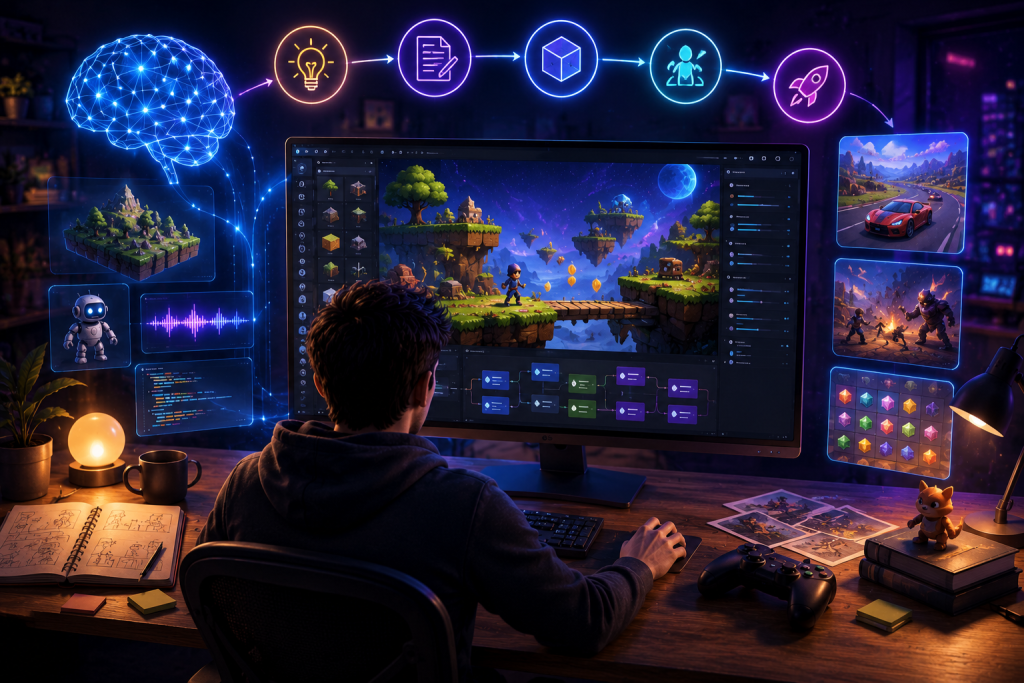
There was a time when calling yourself a “game creator” implied a specific background: computer science degree, years of self-taught programming, or a job at a studio. That definition has quietly expanded, and it’s worth being honest about what actually changed. It wasn’t that game creation got easier to fake. It’s that the tools required to genuinely build something playable stopped demanding a technical background as the price of entry.
If you’ve ever had an idea for a game and assumed it wasn’t realistic without coding skills, that assumption is outdated. Here’s what actually becoming a game creator looks like now, and what it genuinely requires from you.
What “Game Creator” Actually Means Today
Being a game creator was never really about knowing how to code. It was about having ideas worth building and the persistence to see them through. Coding was simply the mechanism that used to stand between those two things. Now that the mechanism has changed, the core of what makes someone a game creator, creative instinct, design judgment, willingness to iterate, hasn’t changed at all. What’s different is that far more people can act on those qualities than could before.
The Starting Point Has Completely Shifted
From Learning Syntax to Describing Ideas
The traditional path into game development started with months of learning a programming language before you could build anything meaningful. The new starting point is simply describing what you want in plain language. Game maker online platforms take that description and handle the technical translation, which means your very first step toward becoming a creator can happen in the same afternoon you have the idea.
From Blank Editors to Immediate Feedback
Opening an empty code editor for the first time is intimidating precisely because there’s nothing there to react to. Starting instead with a rough, playable version of your idea gives you something immediate to respond to, which makes the entire process feel far less like studying and far more like actually creating.
What You Genuinely Need to Get Started
A Specific Idea, Not a Vague One
The clearer you can describe your core mechanic, the better your first prototype will turn out. “A game about survival” is too vague to build around well. “The player collects resources while avoiding an expanding threat” gives you something concrete to test.
Willingness to Play Your Own Rough Draft Honestly
Becoming a real creator, not just someone who generates a prototype once and stops, requires actually playing your early versions and being honest about what isn’t working yet. That honesty is uncomfortable sometimes, but it’s where genuine improvement comes from.
Patience for Multiple Rounds of Iteration
Your first generated version won’t be your best one. Expect to adjust, test, and refine several times. Games like Ragdoll Slingshots show what that kind of iterative process can produce, a simple physics-based mechanic that clearly went through real refinement to feel as satisfying as it does, not something that arrived fully formed on the first attempt.
A Realistic Path From Curious to Creator
Step 1: Start With Something You’d Actually Want to Play
Building a genre you enjoy as a player gives you an internal sense of what “good” feels like, which matters enormously when you’re evaluating your own rough prototypes without much prior experience to draw on.
Step 2: Describe Your Core Mechanic Clearly
Take the time to articulate exactly what the player does, repeatedly, that should feel satisfying. This single step has more influence over how good your first prototype feels than almost anything else in the early process.
Step 3: Generate a Rough Version and Play It Immediately
Resist the urge to imagine how it’ll feel before actually playing it. Real information beats speculation every time, and this is the step that turns you from someone with an idea into someone actually building something.
Step 4: Get Someone Else to Try It
Even one honest reaction from someone unfamiliar with your project reveals things you can’t see on your own. This step is uncomfortable for a lot of first-time creators, but it’s genuinely one of the fastest ways to improve.
Step 5: Refine Based on What You Actually Observed
Change one thing at a time based on real feedback, not assumption. This is where the actual skill of game creation develops, through repeated cycles of testing and adjustment rather than through any single flash of inspiration.
Step 6: Finish It, Even If It’s Small
A completed small project teaches more than an ambitious one left unfinished. Becoming a game creator in any meaningful sense requires actually finishing something and putting it in front of real players, not just endlessly prototyping.
What Still Separates a Good Creator From a Mediocre One
Genuine Curiosity About Why Things Work
The creators who improve fastest aren’t just generating and adjusting mechanically, they’re asking why a particular version felt better, developing real intuition they carry forward into future projects.
Comfort With Being Wrong Early and Often
Your first instinct about what will feel fun is frequently wrong, and that’s completely normal. Good creators treat that as useful information rather than a personal failure, and they adjust quickly instead of getting attached to an idea that isn’t working.
A Habit of Playing Other Games Critically
Noticing what makes other games satisfying, or frustrating, sharpens the instincts you bring to your own projects. Passive play teaches less than play where you’re actively asking what a designer was trying to accomplish with a specific choice.
Common Doubts That Shouldn’t Stop You
“I Don’t Have Anything Original Enough”
Originality in game creation usually comes from execution and personal taste layered onto familiar foundations, not from inventing something no one has ever seen. Most beloved games build on recognizable mechanics executed with real care.
“I’m Not Creative Enough”
Creative instinct shows up in a lot of forms beyond obvious artistic talent, sense of pacing, understanding of fairness, curiosity about what makes something fun. If you’ve ever had a strong opinion about why a game you played felt good or bad, that instinct is exactly what game creation draws on.
“I Don’t Have Enough Time”
Because prototyping and iteration happen so much faster now, the time investment required to genuinely try game creation has shrunk dramatically. A rough first project is realistically achievable in far less time than most people assume before trying.
Final Thoughts
Anyone can become a game creator now in a way that simply wasn’t true a decade ago, not because the creative and design skills that make a game good have become easier, but because the technical barrier that used to filter out everyone without a programming background has been removed. What’s left is the actual work of creation: having ideas, testing them honestly, and refining based on what real players experience.
If you’ve had a game idea sitting unbuilt because you assumed it required skills you don’t have, that assumption no longer holds. The only genuine requirement left is starting.