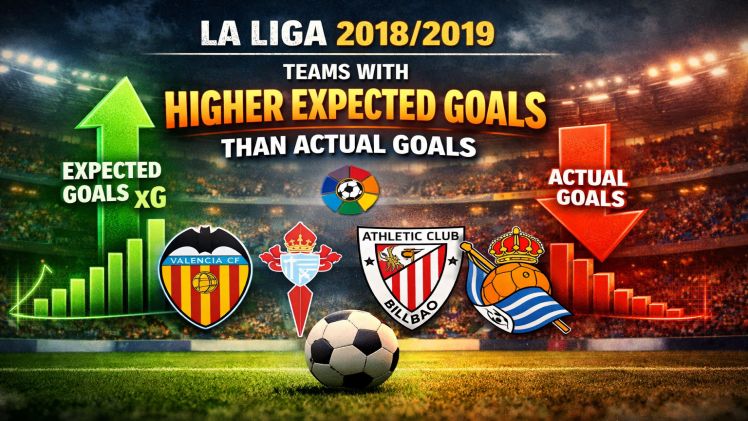
During the 2018/2019 La Liga season, several teams generated more quality chances than their goal records suggested. This imbalance, where expected goals (xG) exceeded actual goals, often indicated sides underperforming finishing-wise but poised for eventual turnaround. Understanding these discrepancies allows bettors and analysts to identify teams likely to rebound — a logic-driven, data-based view rather than one built on surface-level form.
Why xG Matters More Than Raw Scores
Expected goals (xG) capture chance quality rather than just outcomes. A team with 2.0 xG but zero goals in a match is not necessarily weak — it might be unlucky or temporarily inefficient. Over a long season, finishing variance tends to normalize, and teams generating consistent high xG usually climb back toward their statistical equilibrium. Hence, xG provides a deeper analytical foundation for predicting performance corrections.
The 2018/2019 Pattern of Underperformance
In La Liga 2018/2019, clubs such as Valencia, Athletic Bilbao, and Real Sociedad often registered xG numbers surpassing their goal tallies in the first half of the season. This gap reflected both inefficiency in finishing and short-term variance. The eventual improvement of these teams in later months validated the rebound principle — expected goals had signaled recovery before the scoreboard did.
Mechanisms Behind xG-Gap Reversals
When xG exceeds actual goals, several mechanisms may trigger a rebound over time:
- Regressed finishing efficiency returning to normal levels.
- Stable chance creation maintaining attacking volume.
- Psychological lift following a breakthrough match.
- Managerial adjustment improving shot selection or lineup balance.
Each mechanism represents a self-correcting force. Once finishing variance subsides or tactical roles stabilize, results often align with underlying metrics — a process visible in mid-season recoveries.
Recognizing Teams on the Verge of Recovery
To spot teams poised for comeback, data watchers track rolling averages of xG versus actual goals. When a club’s chances persistently outpace outcomes across 5–7 matches, yet possession and shot metrics remain strong, the case for an approaching correction strengthens. The underlying stability in process — not temporary volume — distinguishes real rebound value.
Reading the Market Response Through UFABET
In live betting contexts, such as those accessible via ทางเข้าufabet, understanding the xG-to-goal gap can identify mispriced situations. When public sentiment overreacts to goal droughts, odds undervalue consistent creators. Observing a data-driven mismatch between team quality indicators and market pricing offers opportunities to back eventual recovery phases. Applying this logic requires tracking both match data and shifting lines, recognizing that the market’s adjustment often lags behind metrics.
Long-Term Value in Overlooked Efficiency
Teams with suppressed output relative to xG frequently become undervalued because casual followers interpret poor scoring runs as declining quality. Yet the long-term signal suggests ongoing strength masked by randomness. By aligning value bets with these statistical imbalances, bettors benefit from odds reflecting temporary perception, not lasting truth.
Comparing xG Gaps Across Leagues
Conditional Variance in Context
While similar trends appeared in other European leagues, La Liga’s 2018/2019 season featured unusually tight margins between mid-table clubs. This context amplified the influence of finishing sequences: slight underperformance could obscure structural progress. Unlike the Premier League, where elite sides dominate possession, Spain’s competitive parity rendered xG analysis an even more accurate early-warning system for rebounds.
Data Interpretation and Timing in casino online
Occasionally, bettors exploring analytical discussions within casino online environments find these team-level metrics vital to timing wagers. When analyzing form cycles, users should not assume immediate correction after underperformance. The data’s relevance depends on persistence and confidence intervals — short-term noise may distort perception. Thus, integrating xG review with contextual awareness of fatigue, fixture congestion, and tactical setup refines judgment inside these analytical communities.
Common Misreadings and Model Weaknesses
A recurring mistake involves assuming every xG deficit guarantees improvement. Some teams suffer systemic inefficiencies — poor shot locations, weak conversion ability, or tactical imbalances — that data alone cannot fix. Pure reliance on numbers without contextual football knowledge risks overestimating rebound likelihood. Analytical depth requires merging quantitative evidence with situational insight from match viewing and squad profiles.
Summary
La Liga 2018/2019 offered a statistical microcosm of how xG imbalances reveal hidden strength. Teams posting consistently higher xG than their scoring record eventually experienced performance correction once short-term inefficiency eroded. For data-driven analysts, these episodes verified that process-based metrics outlast perception-based narratives. Recognizing such patterns remains crucial not only for interpreting football form but also for identifying value in dynamic betting markets.