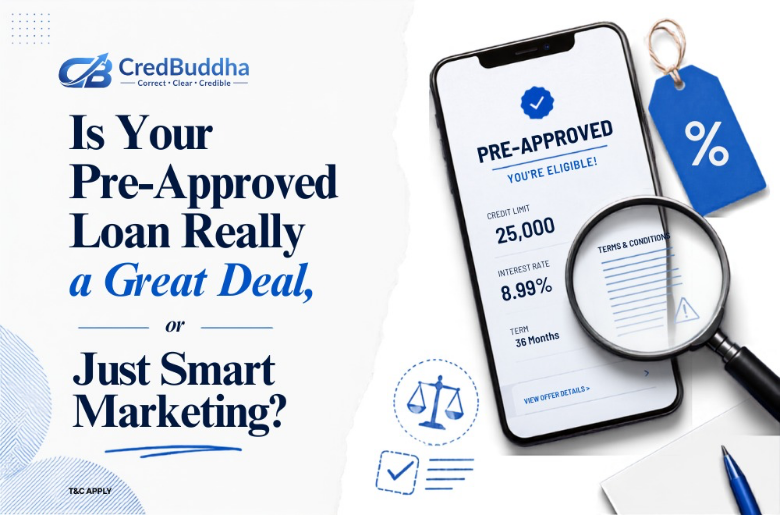
While a pre-approved personal loan might offer faster approval, its value is dependent upon pre-approved loan eligibility, interest rate, fees, and terms. To help borrowers in making decisions, this article explains pre-approved loan offers, pre-approved loan advantages, pre-approved loan drawbacks as well and pre-approved loan vs. regular loan.
What is a Pre-Approved Personal Loan?
A pre-approved personal loan is an offer made to certain customers by a bank or NBFC based on information it already holds, without requiring them to submit a new application. In order to get to this particular, the lender shortlists individuals who fit into a low-risk group by looking at internal banking records, credit reports, and previous repayment patterns. This offer usually reaches the customer through an SMS, a net banking message or a notification on the mobile app.
Pre-approved and pre-qualified offers are not the same. A pre-approved personal loan is generally based on internal banking data along with credit bureau information with detailed assessment of account behaviour, while a pre-qualified offer typically relies on credit bureau data and basic credit score assessment with lower likelihood of final sanction. A pre-approved tag does not mean the loan amount shown is guaranteed – it only indicates that the applicant meets a preliminary eligibility bar. The final sanction still depends on verification at the time of acceptance.
How Banks Select Customers
Lenders do not send pre-approved loan offers randomly. Selection is based on internal and external data that indicate how reliably a customer manages credit, including credit score, bureau report, regularity of salary credits, length of banking relationship, credit card utilisation and repayment patterns and past loan repayment history. Banks also consider behaviour on existing loans, including missed EMIs, average account balance maintained over time and internal risk analytics scoring. The Fixed Obligation to Income Ratio (FOIR) is another key factor – it refers to the proportion of a borrower’s monthly income that goes toward existing financial obligations including EMIs, credit card dues and rent.
Pre-Approved vs Regular Personal Loan
A pre-approved personal loan is based on existing bank or bureau data, while a regular personal loan is assessed afresh. Pre-approved loans can be approved within minutes to a few hours with minimal, often pre-filled documentation and largely automated processing, whereas regular loans may take 1–7 working days and generally require full income and KYC documents with manual underwriting.
Pre-approved personal loan offers may carry preferential interest rates for existing customers, while regular loans are priced after fresh risk assessment. Pre-approved loans are usually accessed through an app or net banking, whereas regular loans may be processed online or through a branch. However, the pre-approved amount remains indicative until verified, unlike a regular loan sanctioned after full underwriting.
Charges and Hidden Costs
Beyond the headline interest rate, several charges can influence the actual cost of a pre-approved personal loan. These may include a processing fee of 0.5%–3% of the loan amount, 18% GST on applicable fees and documentation charges. Borrowers should also check EMI bounce charges of ₹300–₹750, late payment fees of 1%–2% per month on overdue amounts and foreclosure charges of up to 5% of the outstanding principal. The RBI’s digital lending guidelines require lenders to spell out the Annual Percentage Rate (APR) and every associated charge in a standardised Key Fact Statement (KFS).
When Offers Change or Get Rejected
The amount shown in a pre-approved personal loan offer is indicative, not final. The amount can change after verification if declared income does not match ITR, salary slips or Form 16 or if a high FOIR is identified. Multiple recent credit enquiries, a recent job change or income instability can also affect the offer. A drop in credit score between the offer generation and acceptance may further lead to a reduced, delayed or rejected loan.
Spotting Fraudulent Offers
With digital lending on the rise, fraudulent messages mimicking real pre-approved loan offers have increased. RBI has cautioned borrowers about fake loan-app links and unsolicited SMS offers. Unknown or unofficial senders, upfront fee requests, unofficial links and pressure to accept immediately are key red flags. A genuine pre-approved personal loan offer should be visible through the official net banking portal or app with no upfront payment before verification. The lender should also be a registered bank or an NBFC listed with RBI.
Making the Decision
A pre-approved offer makes sense to accept when there’s an actual need for the money, the EMI sits comfortably within the monthly budget, the interest rate holds up well against other options in the market, repayment terms allow flexibility and every charge is transparent. Conversely, it’s worth declining if there’s no real requirement for funds, the rate quoted is higher than alternatives, fees seem steep, existing debts are already accumulating or repayment capacity feels stretched. Before accepting any pre-approved personal loan offer, compare multiple online pre-approved personal loan options from banks and NBFCs, verify the lender’s authenticity and review all loan terms carefully.
For more information, visit our website – CredBuddha.
You can also explore Personal Loans options and find a loan suited to your financial needs.