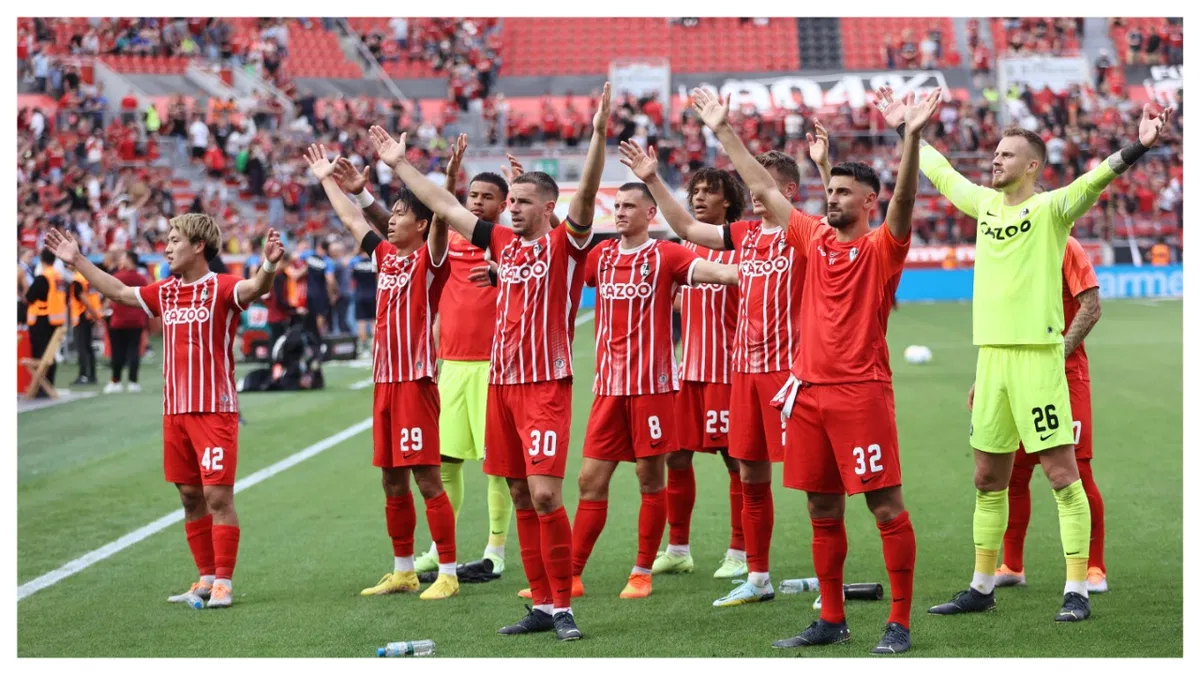
The underlying question is whether Bundesliga teams that patiently combine around the edge of the box during 2024/25 open themselves up to counter-attacks more than more direct sides. Possession near the penalty area can suffocate opponents and generate high-quality chances, but every extra pass taken against a compact block carries a trade-off in transition risk once the ball is lost.
Why patient edge-of-box play has grown in the Bundesliga
Over the last seasons, several Bundesliga teams have doubled down on patient circulation in the final third, aiming to move blocks side to side before threading incisive passes. Sides such as Bayern Munich, Bayer Leverkusen, Stuttgart and Borussia Dortmund show high possession and strong completion rates on passes in advanced zones, relying on structured positional play to create shooting lanes rather than early crosses or long shots. That shift raises the stakes around the edge of the area: losing the ball high up with many players advanced can create perfect launchpads for counters, especially against opponents drilled in fast transitions.
How edge-of-box passing structures possession and risk
Teams that enjoy circulating the ball in front of the box typically commit multiple players between the lines, keeping full-backs high and often leaving only two defenders plus a holding midfielder behind the ball. This structure maximises short passing options and positional rotations, increasing the likelihood of carving out a good chance but also concentrating bodies in narrow spaces where a miscontrol or interception can flip the pitch in seconds. The more touches these sides take in congestion, the more transition “entry points” they create, so their attack-versus-risk balance hinges on their ability to counter-press immediately once possession is lost.
Mechanism: from slow circulation to fast counter
Once the ball is turned over near the D, the geometry of the pitch suddenly favours the defending side, which now becomes the attacker. The compactness that previously helped the defending team close down passing lanes becomes a springboard for quick combinations into open space, particularly if they have pace up front. Because the possession-heavy team’s full-backs and midfielders are already high, a single vertical pass or wall pass can bypass their first line of pressure and unleash runners into large gaps, producing counter-attacks that generate high expected goals against in the first 8–15 seconds after the turnover.
Conditional scenarios that increase or reduce exposure
The degree of counter-attack exposure for edge-of-box possession teams depends on several conditions. When the team couples their patient attacks with intense, well-timed counter-pressing and compact rest-defence, their xGA after turnovers can remain manageable despite aggressive positioning, as seen in improvements reported for Dortmund across phases of the 2024/25 season. By contrast, if their spacing behind the ball is loose or their midfield lacks mobility, each lost pass on the edge of the box has a higher probability of turning straight into a clear transition shot the other way, reflected in elevated xGA numbers for teams that press inconsistently.
Identifying edge-of-box possession profiles in data
From a data standpoint, teams that “linger” around the box can be spotted through combinations of high overall possession, strong completion in final-third passes and large volumes of touches near the opposition penalty area. In the Bundesliga context, clubs like Bayern, Leverkusen, Stuttgart and Dortmund exhibit these traits, pairing control in the opponent half with structured attacks that do not always translate directly into box entries. When such teams also show increased xGA immediately after losing the ball, analysts can infer that some of their patient play is not fully backed by effective transition protection, marking them as candidates for volatile matches with both long attacking spells and sudden counters.
When someone wants to convert these patterns into practical decision-making, using an online betting site like ufabet เว็บตรง becomes a way to test how strongly markets price in this double-edged style; by checking odds on both the possession-heavy favourite and counter-related props, a bettor can judge whether the risk of quick breaks against is fully reflected in lines on goals, shots or even upset results. If the market treats a high-possession side as almost invulnerable defensively despite data hinting at transition fragility, the mismatch between stylistic risk and quoted probabilities may highlight opportunities where edge-of-box control coexists with a genuine chance of being caught out.
Table: possession/control indicators and counter-risk signals
One way to bring structure to this analysis is to compare simple indicators that represent edge-of-box possession with metrics that hint at counter-attack exposure. This bridges the gap between descriptive style labels (“patient build-up”) and measurable consequences (expected goals against after turnovers, shots faced from transitions) for key Bundesliga sides in 2024/25.
| Team | Possession % trend (league context) | Final-third pass success (relative) | xGA level (overall) | Implied counter-attack risk profile |
| Bayern Munich | Among highest in league | Very high, around mid‑80s in final third | Low overall xGA | Edge-of-box play largely protected by strong rest-defence and counter-pressing |
| Bayer Leverkusen | High controlled possession | Low‑80s final-third success | Relatively low xGA | Patient build-up with moderate counter threat when counter-press fails |
| VfB Stuttgart | Upper-tier possession | High final-third accuracy | Mid-range xGA | More open contests; structured attacks but occasional exposure in negative transitions |
| Borussia Dortmund | Strong possession, more vertical phases | High passing quality in advanced zones | Improved xGA after ball losses in later season phase | Initially vulnerable, later better-balanced between patient play and transition security |
This type of comparison prevents over-simplified assumptions that all possession teams share the same counter-attack risk. It shows that similar edge-of-box passing profiles can coexist with very different defensive outcomes depending on counter-press intensity, player athleticism and coaching adjustments across the season. For bettors and analysts, the table reinforces the need to read both halves of the equation – control and vulnerability – rather than treating patient circulation as either automatically safe or inherently risky.
Lists of signals that a team is about to be countered
In game states where a team insists on combining in front of the box, certain patterns consistently precede dangerous counters. Recognising them in advance provides a practical edge, especially for those following Bundesliga matches with an eye on goals or momentum swings rather than just final scores. The focus should be on causes, not outcomes: spacing, decision speed and opponent posture often announce the counter-attack before the ball is actually lost.
Key warning signs that edge-of-box possession is drifting into counter-attack danger:
- The attacking team’s full-backs are simultaneously high and narrow, leaving only centre-backs to cover large spaces behind.
- Midfielders receive on the half-turn under pressure without a clear backward passing option.
- The opposition’s wide forwards stay high and central instead of tracking back, ready to sprint into space once the ball is won.
- Multiple consecutive passes go sideways or backwards around the D, indicating stagnation rather than penetration.
- Turnovers happen more frequently after risky vertical passes into crowded zones, rather than controlled recycling.
Interpreting these signs in real time allows observers to anticipate when a long possession spell is about to flip into a fast break the other way. Rather than reacting only after a counter chance appears, watching how full-backs, midfield outlets and opposition forwards position themselves creates a running estimate of transition probability with every extra pass around the box. Over multiple matches, this habit helps distinguish genuinely controlled patient play – backed by secure rest-defence – from fragile passing sequences that merely look dominant until a single interception exposes how stretched the structure has become.
Live-game perspective and casino online dynamics
During live matches, edge-of-box possession interacts strongly with the tempo and psychological rhythm of both teams, which can reshape counter-attack probabilities minute by minute. If the nominally dominant side grows impatient and starts forcing risky passes through crowded lanes, their turnover rate in dangerous central areas often spikes, creating more opportunities for opponents to break into open grass. When someone is following this unfolding pattern through a casino online website that updates lines on total goals or next-team-to-score, the divergence between sterile possession and sharp counters can become a crucial factor in deciding whether to back the favourite or anticipate an underdog strike from a transition.
On the other hand, if the possession team tightens its structure – for instance by keeping one full-back deeper or using safer circulation before choosing moments to accelerate – the immediate counter threat can drop significantly even though the share of the ball remains high. In those situations, live markets might still overreact to isolated breaks or crowd noise, while careful observers recognise that the underlying risk profile has improved and adjust their expectations accordingly. The central task is to interpret edge-of-box passing not as a static label but as a dynamic behaviour that can swing from controlled dominance to reckless exposure depending on how the match evolves.
Where the possession-and-counter narrative breaks down
The idea that patient edge-of-box play always leads to vulnerability is tempting but incomplete. Some Bundesliga teams use their dominance in advanced zones to limit counter-attacks by strangling opponents’ ability to play even the first forward pass, pressing immediately with several players around the ball. For those sides, high possession combined with secure spacing actually reduces transition frequency, turning the edge of the box into a pressure cooker rather than a trap.
Moreover, not all opponents are equipped to punish turnovers, even when they occur in ideal counter-attack locations. Teams with limited pace, poor decision-making in transition or conservative game plans may win the ball and still fail to exploit the space behind, which lowers the real danger despite what the structure theoretically allows. In those matches, edge-of-box possession can be sustained with relatively little downside, blurring the simple correlation between patient attacking and counter-threat and reminding analysts to factor in both sides’ capabilities.
Summary
In the 2024/25 Bundesliga, teams that prefer patient combinations around the edge of the box occupy a delicate balance between control and exposure, as every additional pass in tight spaces raises both the chance of a crafted opening and the risk of a costly turnover. Data on possession, final-third passing and expected goals against after ball losses shows that similar stylistic profiles can lead either to safe dominance or to transition-heavy matches, depending on counter-pressing intensity and structural discipline behind the ball. For tactically aware fans and bettors, the key is to read how edge-of-box behaviour interacts with opponent strengths and live-game dynamics, turning a broad narrative about “patient teams being countered” into a nuanced, match-specific judgment rather than a blanket assumption.